
Showing posts with label history. Show all posts

Saturday, September 3, 2011

The New New Scrum Rules of Play

(Deze blogpost is ook beschikbaar in het Nederlands)
Ten years after the creation of the Agile Manifesto and the publication of the first book on Scrum, sixteen years after the first presentation of Scrum at OOPSLA'95 and Twenty Five years after the publication of a scientific article that inspiered the name Scrum, the new Scrum Guide 2011 by Ken Schwaber and Jeff Sutherland is out. It has some great new insights to offer. In this post we will take a brief look at the history of Scrum, see what this new Scrum Guide has to offer and visualize the New New Scrum Rules of Play. This can be of interest to people with some knowledge of Scrum but can hold insights for experienced Scrum practitioners as well.
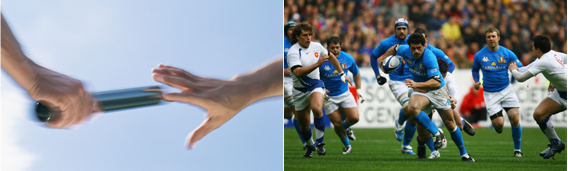
Figure 10: Relay Race versus Rugby

Friday, May 6, 2011

Introducing Agile

In the mid 1990’s, as a reaction to heavyweight waterfall based processes, some other methods emerged. Good examples of these methods are DSDM, RAD, Crystal, XP and Scrum. Not that the people behind them were against process. They just strived to free themselves of Dilbert-like manifestations of process in corporate life, of people hiding behind pointless regulations, managers disrupting the working environment and enforcing unfounded plans and teams producing hundreds of pages of documentation that were impossible to maintain and hardly ever used. They strived for cooperation instead of throwing the result of hard work over a cubicle wall without a proper transfer session and without a clue of what the person on the other side of that wall would be going to do with it.

Friday, April 15, 2011

Introducing RUP

In the late 80s and early 90s Ivar Jacobson, James Rumbaugh and Grady Booch, also called the three amigos, were each working on combining object oriented modeling and iterative development. The Rational Software Corporation, a software vendor specialized in tooling to support software development, brought them together. Their mission was to unify their methods.

Friday, February 18, 2011

A Short History

Software development started with the arrival of the first computers in the 1960’s. Programming started to be hard-wired (fixed programming) or soft-wired (reprogramming was possible by changing the position of plugs). Later, programs could be fed to the computer. First in binary code, then assembler languages were developed (second generation) which were more readable to programmers. The next step in programming was the introduction of procedural languages (third generation) like Cobol and Basic. Although these languages were even closer to the human language and hide a lot of low level procedures and direct addressing of memory from the programmer, they were still modeled close to how a computer works, performing a number of tasks in the right order to get to the right result. But since computers were mainly concerned with heavy data processing and number crunching in those days, procedural languages worked fine.