
Scrum is a framework for self-organization of Agile teams. Although this seems a simple statement we are going to repeat it:
Scrum is a framework
for self-organization
of Agile teams
Let’s take a closer look at the three parts of this statement.
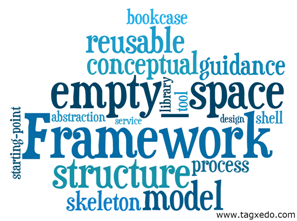 |
| Figure 8: Word Cloud on the Term Framework |
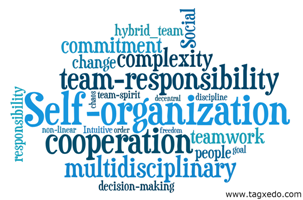 |
| Figure 9: Word Cloud on the Term Self-organization |
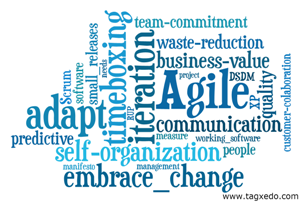 |
| Figure 10: Word Cloud on the Term Agile |
Agile teams conform to the Agile values that we explained in the previous section. The word cloud in Figure 11 shows a collection of aspects that are associated with Agile. Scrum doesn’t say much about how an Agile team should be formed, it just supposes it is used in the context of a team that follows the Agile values and uses specialist practices from other agile methods. Furthermore Scrum presupposes a support and management organization that enables self-organization of Agile teams.
To improve the self-organizing capability of an Agile team the Scrum framework introduces three pillars as shown in Figure 12. These pillars form the basis for the whole Scrum process that we will explain in the next section.
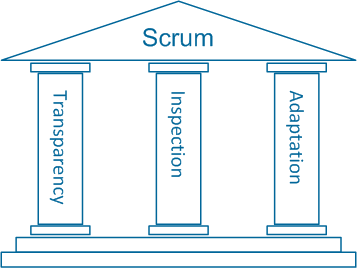 |
| Figure 12: Scrum Pillars |
Transparency is all about clarity in goals, planning and results. In the Scrum process long term and short term goals and plans are made visible and realistic. Results are measured only in terms of usable software. Inspection is all about taking time to look back on the product and on how things get done followed by making concrete plans to improve. Adaptation is all about taking action on these plans and experiment to improve the product and empirically find better ways of doing things. Inspection and Adaptation form a continuous improvement cycle throughout the Scrum process.
Part 3 of this post is Be Transparent.
Other Relevant Posts:
Introducing Agile
The Agile Spirit


But most of all, start doing Agile, inspect and adapt and keep it simple stupid! :-)
ReplyDeleteScrum is presented as a framework that supports self-organization within Agile teams, where teams have room to develop specialist practices and organize their work based on their own experience. In this context, Domains of Computer Science can help students understand the wider areas in which software projects are developed, while providing a broader view of the technical domains that Agile teams may work within.
DeleteFor students applying Scrum principles to software development projects, IEEE Projects for CSE can provide a practical project context for organizing requirements, dividing work among team members, forecasting tasks, and iteratively developing a solution. This connects with the source's emphasis on multidisciplinary teams, clear goals, self-organization, and specialist practices within an Agile environment.
DeleteThis is such an amazing blog, meaningful content with some meaning unlike those useless blogs on the internet. Independence Day Sms Advance 2018
ReplyDeleteHey There. I found your blog using msn. This is a very well written article. I’ll be sure to bookmark it and come back to read more of your useful info. Thanks for the post. I’ll definitely return 먹튀검증사이트
ReplyDelete